



David and Goliath Story
The David and Goliath story is one of the most beloved accounts in all of Scripture — a shepherd boy, a terrifying giant, five smooth stones, and a victory that changed a nation. But this is far more than a children’s tale. It is a story about faith over fear, about God’s power in unlikely people, and about facing the giants in your own life.
Found in 1 Samuel 17, the story unfolds in the Valley of Elah, where the armies of Israel and Philistia faced each other in a standoff. For forty days, the giant Goliath taunted Israel, and no one dared answer — until a teenage shepherd arrived with bread and cheese for his brothers and could not stand to hear God’s name defied.
Below is the story retold, followed by seven powerful lessons for your own battles.
What Is the Story of David and Goliath?
What is the story of David and Goliath? It is the biblical account in 1 Samuel 17 of young David, a shepherd boy, defeating Goliath, a Philistine giant over nine feet tall, with a single stone from his sling. When Israel’s army cowered in fear for forty days, David volunteered to fight — not in Saul’s armor, but with his shepherd’s sling and five smooth stones. Declaring “the battle is the LORD’S” (1 Samuel 17:47), David struck Goliath in the forehead, and Israel routed the Philistines. The story teaches that victory comes through faith in God, not human strength. For the key passages, see a topical collection of Bible verses on David and Goliath.
The Story of David and Goliath (1 Samuel 17)
The Giant’s Challenge
The Philistines gathered for war at Socoh, and Israel’s army camped in the Valley of Elah. Each morning and evening for forty days, a champion named Goliath of Gath strode into the valley. He stood over nine feet tall, wore bronze armor weighing about 125 pounds, and carried a spear like a weaver’s beam. His challenge was simple: send one man to fight him, and the losing nation would serve the winner.
King Saul and all Israel were “dismayed, and greatly afraid.” Not one soldier volunteered. The giant’s taunts echoed unanswered — until an unlikely hero arrived on an errand.
The Shepherd Arrives
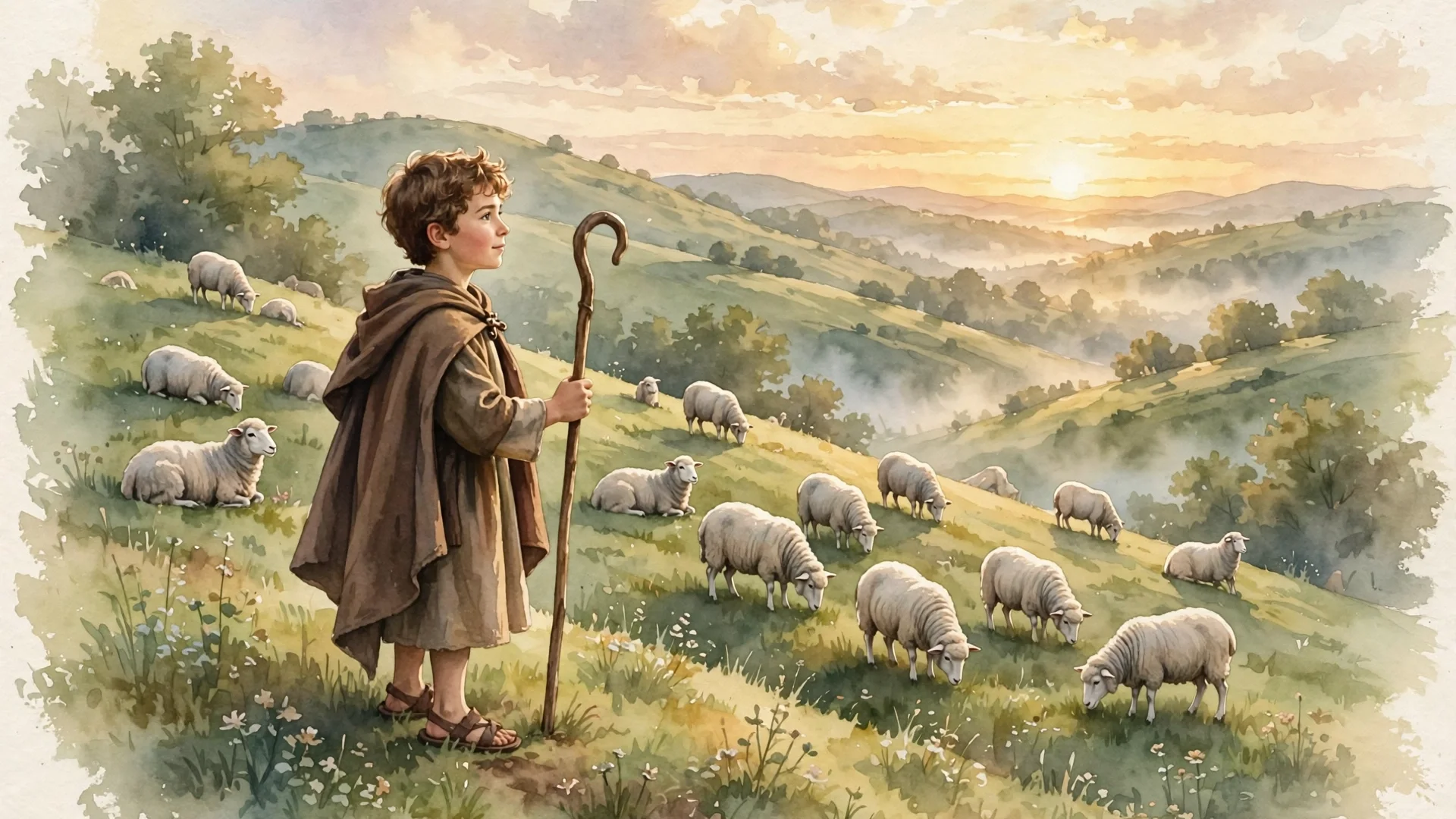
David, the youngest of Jesse’s eight sons, was not a soldier. He tended sheep and had been sent by his father to bring food to his three oldest brothers on the front lines. When David heard Goliath defying “the armies of the living God,” something rose up in him that forty days of fear had not produced in the army: holy indignation.
“Who is this uncircumcised Philistine, that he should defy the armies of the living God?” David asked. His brothers mocked him. King Saul doubted him — “Thou art but a youth.” But David told the king about the lion and the bear he had killed while guarding his sheep, and declared his confidence: the same God who delivered him then would deliver him now.
The Battle
Saul dressed David in his own armor, but David refused it — he had not tested it, and it did not fit. Instead, he took his staff, his sling, and five smooth stones from the brook. Goliath laughed at the boy approaching with a stick.
Then David spoke the words that define the story:
“Then said David to the Philistine, Thou comest to me with a sword, and with a spear, and with a shield: but I come to thee in the name of the LORD of hosts, the God of the armies of Israel, whom thou hast defied.” — 1 Samuel 17:45 (KJV)
David ran toward the giant, slung a single stone, and struck Goliath in the forehead. The giant fell face-down. David took Goliath’s own sword and finished the victory. The Philistines fled; Israel pursued. A shepherd boy with a sling had toppled a nation’s terror — because the battle belonged to the Lord.
7 Lessons from the David and Goliath Story
1. Face Your Giant in God’s Name, Not Your Own Strength
David’s confidence was never in his aim — it was in his God. “I come to thee in the name of the LORD of hosts.” Your giants — fear, addiction, debt, illness, impossible situations — are not defeated by your power but by His. Go into every battle under heaven’s banner, not your own.
2. Remember Your Lion-and-Bear Victories
“David said moreover, The LORD that delivered me out of the paw of the lion, and out of the paw of the bear, he will deliver me out of the hand of this Philistine.” — 1 Samuel 17:37 (KJV)
David’s courage was built on memory. The lion and the bear in the pasture were God’s training ground for Goliath in the valley. When facing a new giant, rehearse your old deliverances. The God who was faithful in the small battles will be faithful in the big one. For more on this kind of courage, see a topical collection of Bible verses on courage.
3. Refuse Armor That Doesn’t Fit
Saul’s armor was the best Israel had — and David rejected it. It wasn’t his. It didn’t fit. He couldn’t move in it. God does not call you to fight your battles in someone else’s armor — their methods, their personality, their calling. Be who God made you to be, and fight with the weapons He gave you.
4. Use What’s in Your Hand
David fought with a shepherd’s tools: a sling, five smooth stones, and a staff. Nothing impressive — until God got involved. Like Moses’s rod and the widow’s jar of oil, ordinary tools become extraordinary in God’s hands. Stop waiting for better resources. Offer God what you have, and watch what He does with it.
5. The Battle Is the Lord’s
“And all this assembly shall know that the LORD saveth not with sword and spear: for the battle is the LORD’S, and he will give you into our hands.” — 1 Samuel 17:47 (KJV)
This is the theological heart of the story. The outcome never depended on David’s skill — it depended on God’s sovereignty. When the battle is the Lord’s, your job is obedience and trust; His job is victory. Release the outcome to Him.

6. Run Toward the Battle
Scripture says David “hasted, and ran toward the army to meet the Philistine” (1 Samuel 17:48). He didn’t inch forward hoping Goliath would fall over. Faith runs. While fear retreats and overthinks, faith advances. Whatever giant you face, take the first step toward it in God’s name — you’ll find He meets you in the running.
7. One Stone of Faith Can Fell a Giant
“So David prevailed over the Philistine with a sling and with a stone, and smote the Philistine, and slew him; but there was no sword in the hand of David.” — 1 Samuel 17:50 (KJV)
It took one stone. Not a hundred — one, guided by God. Your breakthrough may be closer than you think. Don’t despise small acts of faith: one prayer, one step, one stone. In God’s hands, the smallest obedience can topple the biggest giant.
Facing Your Own Goliath Today
- Name your giant. David didn’t fight a vague fear — he faced Goliath. Name yours: the diagnosis, the debt, the addiction, the broken relationship.
- Remember past deliverances. Write down your “lion and bear” moments — times God came through before. Let memory fuel faith.
- Drop borrowed armor. Stop trying to win your battle with someone else’s methods. Be who God made you.
- Pick up your stones. Identify the simple tools God has given you — prayer, His Word, obedience, community — and use them.
- Declare the battle is the Lord’s. Say it out loud like David did. Then run toward your giant, trusting God with the outcome.

Frequently Asked Questions
What is the story of David and Goliath about?
It’s the account in 1 Samuel 17 of young shepherd David defeating the Philistine giant Goliath with a sling and stone — teaching that God gives victory through faith, not human strength.
How tall was Goliath?
1 Samuel 17:4 says Goliath was “six cubits and a span” — roughly nine feet nine inches tall, a true giant among men.
How many stones did David take?
David chose five smooth stones from the brook (1 Samuel 17:40) — though only one was needed to fell the giant.
What does “the battle is the Lord’s” mean?
It means victory depends on God, not human weapons or strength (1 Samuel 17:47). Our part is faith and obedience; God’s part is the outcome.
What can we learn from David and Goliath today?
Face your giants in God’s name, remember past victories, use what God gave you, refuse to wear others’ armor, and trust that the battle belongs to the Lord.
See Also
- Lessons From Joseph of Arimathea
- Obedience is Better Than Sacrifice
- Lessons From the Story of Barabbas
Conclusion
The Valley of Elah teaches us that giants fall — not to the strongest, the tallest, or the best-armed, but to the one who trusts God most. David’s sling was ordinary; his faith was not. His stones were small; his God was not.
Your Goliath has a forehead, too — a vulnerable spot where one God-guided stone can bring the whole giant down. So name your giant. Remember your lion-and-bear victories. Pick up your stones. And run toward the battle declaring what David declared: the battle is the LORD’S.
Giants still fall today. Yours can be next.
