


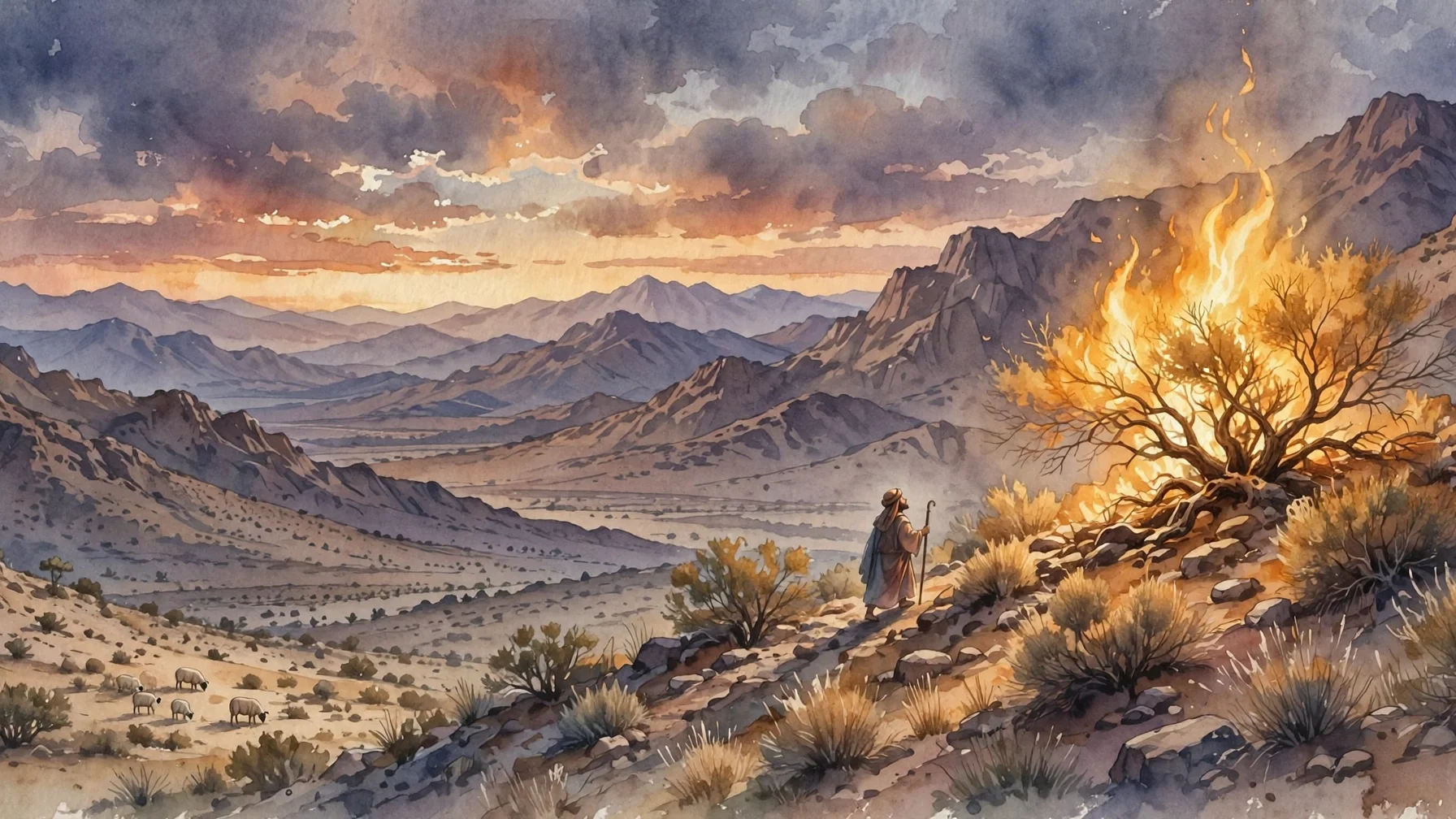
Moses and the Burning Bush Explained
Moses and the burning bush is one of the most dramatic encounters in the Bible — a bush blazing with fire yet never burning up, holy ground in the desert, and God calling an 80-year-old shepherd to confront the most powerful ruler on earth. It is the moment Moses’ life changed forever, and Israel’s deliverance began.
But the burning bush is more than a spectacular story. It reveals who God is — holy, present, compassionate, and faithful to His promises — and how He calls ordinary, reluctant people to extraordinary missions. Below is a clear explanation of Exodus 3-4, the meaning of the burning bush, God’s name “I AM,” and five lessons for your own calling.
What Is the Story of the Burning Bush?
What is the story of the burning bush? While tending sheep in Midian, Moses sees a bush burning with fire but not consumed. God calls to him from the bush, tells him to remove his sandals on holy ground, reveals He has seen Israel’s suffering in Egypt, and commissions Moses to lead them out. God reveals His name — “I AM THAT I AM” — and answers Moses’ objections with promises of His presence and power (Exodus 3-4). For deeper study, read why God spoke to Moses from the burning bush or Exodus 3 in full.
Moses was 80 years old, a fugitive with a failed past, tending someone else’s sheep in the wilderness. He had given up on changing the world. But God had not given up on him — and the burning bush proved it.
The Setting: An Ordinary Day in Midian (Exodus 3:1)
Moses led his father-in-law Jethro’s flock “to the backside of the desert, and came to the mountain of God, even to Horeb.” Nothing about the day seemed special. He was doing the same job he had done for forty years.
That is often how God works — He breaks into ordinary days. Moses was not praying on a mountaintop retreat or leading a revival. He was at work. If you feel stuck in the ordinary, take heart: the burning bush appeared on a workday.
The Sight: Fire That Does Not Consume (Exodus 3:2-3)
“And the angel of the LORD appeared unto him in a flame of fire out of the midst of a bush: and he looked, and, behold, the bush burned with fire, and the bush was not consumed.” — Exodus 3:2
Fire normally destroys what it touches — but this fire sustained what it touched. The unconsumed bush pictures a profound truth: God’s presence does not destroy His people; it empowers them. Like the bush, Israel would go through the “fire” of Egypt and emerge unconsumed. Like the bush, we can carry God’s fiery presence without being burned up.
Moses said, “I will now turn aside, and see this great sight.” Curiosity led to calling. God often gets our attention with the unusual — pay attention when He does.

The bush burned with fire — and was not consumed.
Holy Ground: Take Off Your Sandals (Exodus 3:4-6)
When God saw Moses turn aside, He called: “Moses, Moses.” And Moses answered, “Here am I” — the same response Abraham, Samuel, and Isaiah would later give. Then came the command:
“And he said, Draw not nigh hither: put off thy shoes from off thy feet, for the place whereon thou standest is holy ground.” — Exodus 3:5
The ground was not special — God’s presence made it holy. Removing sandals was an act of reverence and humility. Before God gives Moses a mission, He teaches him worship: you do not rush into God’s presence casually. Then God introduced Himself:
“Moreover he said, I am the God of thy father, the God of Abraham, the God of Isaac, and the God of Jacob. And Moses hid his face; for he was afraid to look upon God.” — Exodus 3:6
God is the God of generations — the same God who kept promises to Abraham, Isaac, and Jacob was about to keep them again. Moses hid his face: holy fear is the right response to a holy God.
The Call: I Have Seen Their Affliction (Exodus 3:7-10)
Then God shared His heart — four verbs that reveal His compassion:
“And the LORD said, I have surely seen the affliction of my people which are in Egypt, and have heard their cry by reason of their taskmasters; for I know their sorrows; And I am come down to deliver them out of the hand of the Egyptians, and to bring them up out of that land unto a good land and a large, unto a land flowing with milk and honey.” — Exodus 3:7-8
I have seen. I have heard. I know. I am come down. God sees your affliction, hears your cry, knows your sorrows — and He comes down to deliver. Then the stunning turn: “Come now therefore, and I will send thee unto Pharaoh, that thou mayest bring forth my people.” God’s answer to Israel’s cry was a reluctant 80-year-old shepherd. God still answers prayers through unlikely people.
The Name: I AM THAT I AM (Exodus 3:13-15)
Moses asked the question every called person asks: “When they ask me, What is his name? what shall I say unto them?” God’s answer is the most profound self-revelation in the Old Testament:
“And God said unto Moses, I AM THAT I AM: and he said, Thus shalt thou say unto the children of Israel, I AM hath sent me unto you.” — Exodus 3:14
“I AM THAT I AM” means God is self-existent, eternal, and unchanging. He does not become — He simply is. He is not dependent on anything, and He is always present with His people. Centuries later, Jesus would take this name for Himself: “Before Abraham was, I am” (John 8:58). The God of the burning bush is the Christ of the cross.

I AM THAT I AM — the eternal, self-existent God.
Moses’ Excuses and God’s Answers
Moses raised five objections — and God answered every one. His excuses are ours too:
| Moses’ Excuse | God’s Answer |
|---|---|
| “Who am I?” (Exodus 3:11) | “Certainly I will be with thee” (3:12) — it is about who God is, not who you are |
| “What is Your name?” (3:13) | “I AM THAT I AM” (3:14) — the eternal God sends you |
| “They will not believe me” (4:1) | Three miraculous signs: staff to serpent, leprous hand healed, water to blood (4:2-9) |
| “I am not eloquent” (4:10) | “I will be with thy mouth, and teach thee what thou shalt say” (4:12) |
| “Send someone else” (4:13) | Aaron will speak for you — but you must go (4:14-16) |
Notice: God never debated Moses’ inadequacy — He answered it with His presence. “I will be with you” is still God’s answer to every “who am I?” today.
5 Lessons from the Burning Bush
- God meets you in the ordinary. Moses was tending sheep on a workday. Stay faithful in your daily work — God breaks in when you least expect it (Exodus 3:1).
- God’s presence makes ground holy. You do not need a special place to meet God — His presence makes any place holy. Approach Him with reverence (Exodus 3:5).
- God sees, hears, knows, and comes. Your affliction is not invisible to heaven. The God of the burning bush still sees and still delivers (Exodus 3:7-8).
- Your inadequacy is not the issue — His presence is. Every excuse melts before “I will be with thee.” Stop asking “Who am I?” and start trusting “I AM” (Exodus 3:11-12).
- God uses unlikely people. An 80-year-old fugitive shepherd became Israel’s deliverer. Your past failures and present obscurity do not disqualify you (Exodus 3:10).
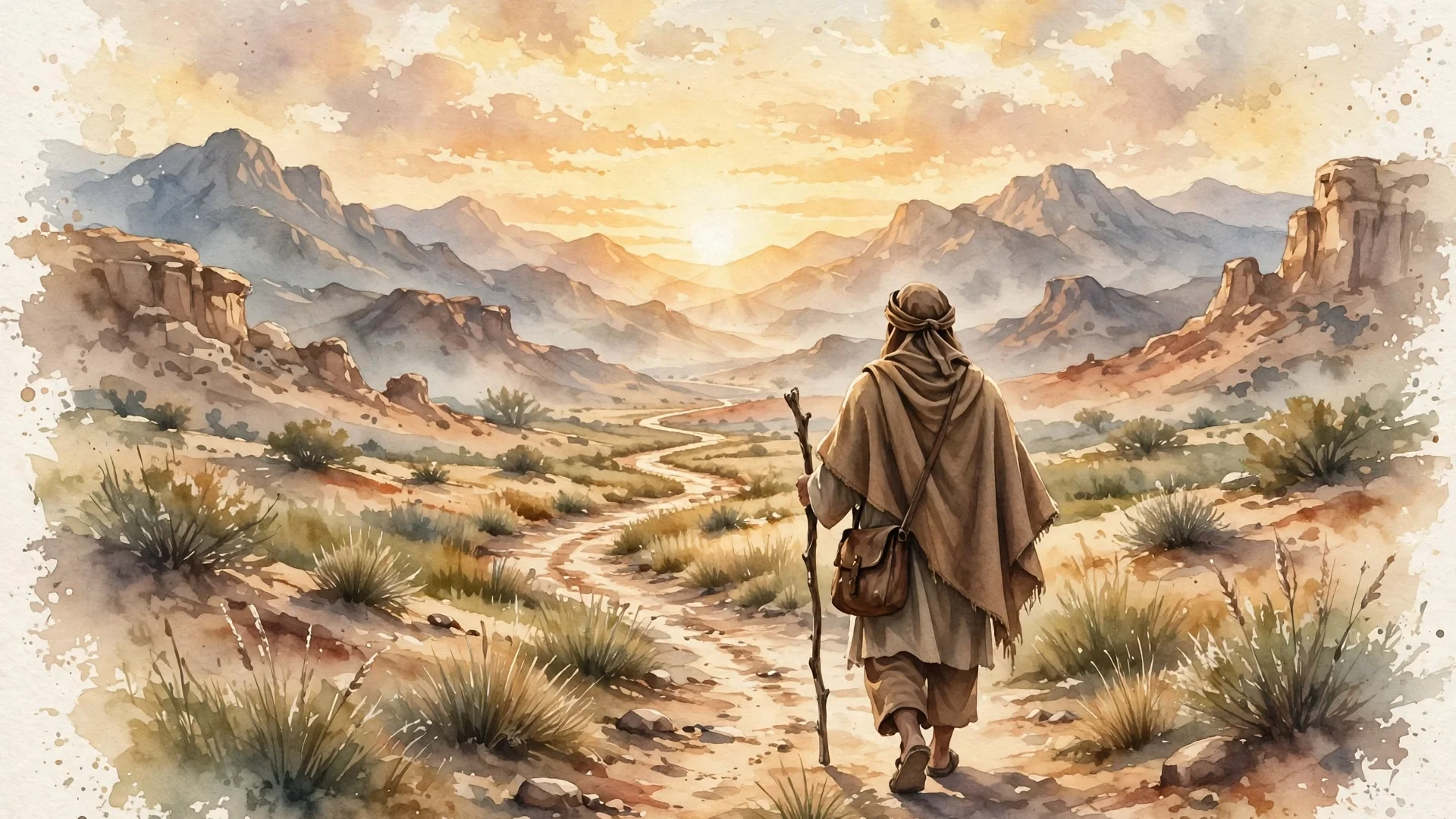
From shepherd to deliverer — God calls the unlikely.
Frequently Asked Questions
Why did God appear in a burning bush?
The unconsumed bush pictured God’s holy presence — fire that empowers without destroying. It showed Moses (and Israel) that God was with them in the fire of affliction and would bring them through unconsumed.
What does “I AM THAT I AM” mean?
It reveals God as self-existent, eternal, and unchanging — the One who simply is, dependent on nothing, always present with His people. Jesus later claimed this name for Himself (John 8:58).
Where is Mount Horeb?
Horeb is another name for Mount Sinai, in the Sinai Peninsula, where Moses tended Jethro’s flocks in Midian and where Israel would later receive the Law.
How old was Moses at the burning bush?
Moses was 80 years old (Exodus 7:7; Acts 7:30) — proof that God can call and use you at any age, even after decades of obscurity.
Why was Moses reluctant to go?
He felt inadequate (a fugitive with a past), unqualified (slow of speech), and afraid of rejection. God answered each fear with the promise of His presence — the same promise He gives us.
See Also
- Moses Trusting God At the Red Sea
- Moses 40 Days on Mount Sinai
- Before Promotion Comes Devotion Story Behind Surgical Love
Conclusion
Moses and the burning bush is the story of a holy God meeting a reluctant man — and changing the world through him. It teaches us that God sees our affliction, hallows ordinary ground, reveals His eternal name, and calls unlikely people with an unshakeable promise: “Certainly I will be with thee.”
What is your burning bush? What has God been calling you to that feels too big? Stop listing your inadequacies and start trusting His presence. Read Exodus 3-4 in full, take off your sandals, and answer like Moses did: “Here am I.”
